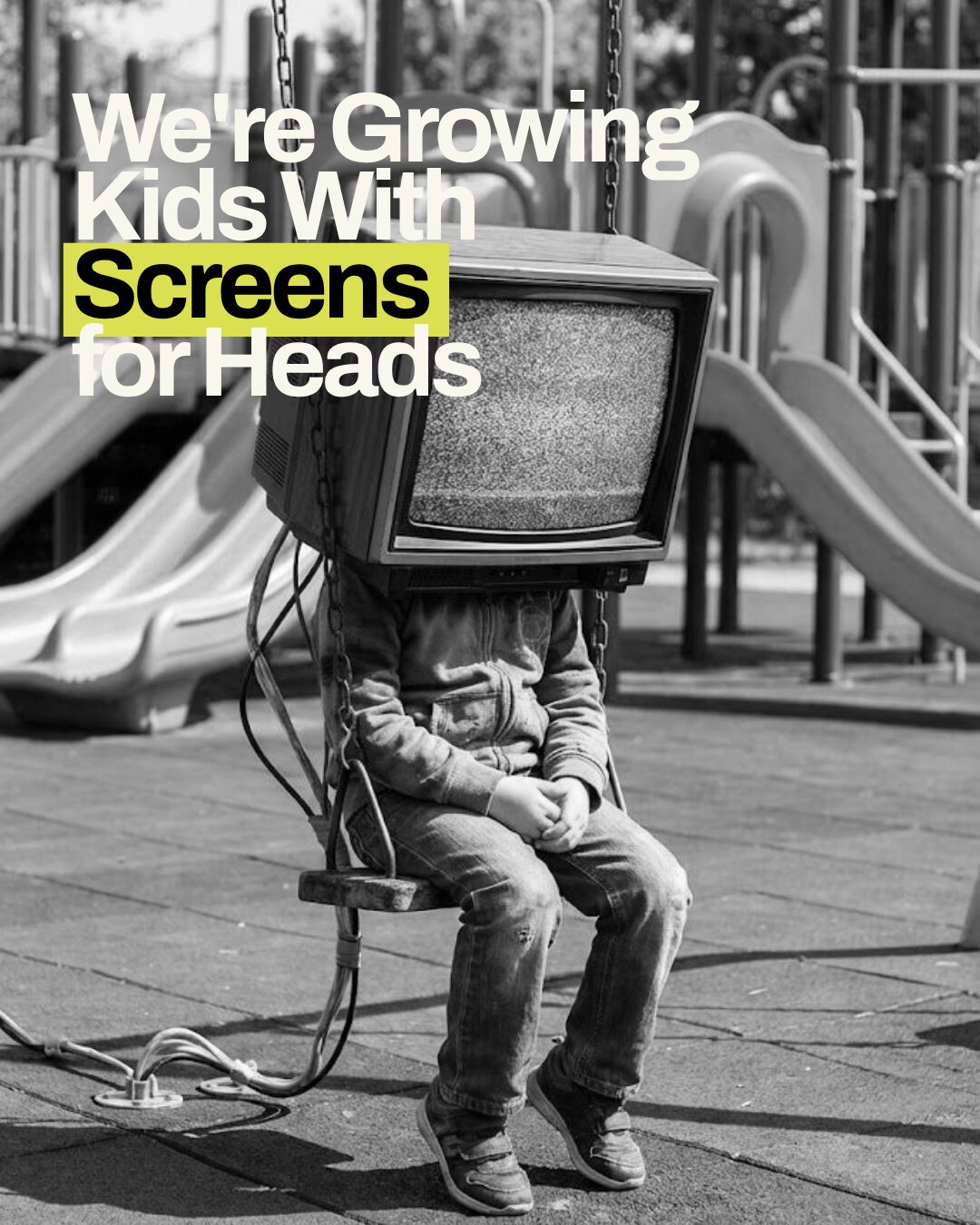
Heads down, never looking up. Here’s why kids need real, unscheduled, undocumented time to build the things a screen can’t build for them.
We’re Growing Kids With Screens for Heads
Walk into most rooms with kids in them right now, and you will see the same thing. Heads down. Faces lit by a screen. Nobody looking up.
We think that image says more than any headline about screen time ever could.
When the screen imagines for you, you stop imagining
Creativity does not come from nowhere. It comes from being bored enough, or curious enough, to make something up yourself, because nothing was handing you an answer already.
A screen hands you the answer already. The story is already made. The joke is already written. The game is already designed by someone else, for you to consume, not to build. None of that is inherently bad on its own. But when it becomes the default, the muscle that used to make things up for itself gets less practice. Not because kids got less imaginative as people. Because the imagining kept getting done for them, faster than they could ever do it themselves.
You cannot learn a room with your head down
Reading a room. Knowing when to speak and when not to. Picking up on how someone actually feels, not what they typed. Handling an awkward silence instead of reaching for a phone to escape it.
None of that gets taught. It gets practiced, in real rooms, with real people, over and over, usually badly at first. If your head is down, you are not in the room. You might be physically present, but you are not doing the practice. And the less that gets practiced early, the harder it is to do later, in the moments that actually matter. A job interview. A hard conversation. A relationship. Those do not go well for someone who has spent their whole life avoiding them for something easier and closer at hand.
The screen is not neutral. It is a place to hide
This is the part that worries us most. A screen does not just distract from real interaction. It offers an alternative to it, one that feels safer because it asks less of you.
Hiding behind a screen instead of showing up in a real interaction does not make the discomfort go away. It just means the discomfort never gets faced, which means it never gets smaller. That has a cost, and it does not show up right away. It shows up later, as someone who finds real connection harder than it needed to be, because they never got the practice everyone else was quietly getting while they were looking down.
And then there is cyberbullying
This one is not abstract. A kid used to get to leave school and go home to somewhere the bullying could not follow them. That does not exist anymore. It comes home in their pocket, and it does not stop at 3pm.
We think that alone is reason enough to take this seriously.
This is not about hating technology
We are not saying screens are the enemy. We use them constantly, for work we care about.
We are saying heads need to come up sometimes. Kids need enough real, unscheduled, undocumented time in actual rooms with actual people to build the things a screen cannot build for them. Imagination. Social instinct. The ability to sit in a hard moment instead of escaping it.
We do not think this is something to just write about and leave there.
If you run a business, a brand, or an organisation that believes the same thing, that kids need more real time outside and less time behind a screen, we want to hear from you. We are looking for people who want to actually put something behind this, not just agree with it in passing.
Get in touch if you want to get involved. Let’s build something that actually gets kids looking up again.

A business can have an exceptional product, a brilliant team and a very clear idea of what it stands for, but that clarity only gets you so far if nobody outside the company can see it. This is where creative tends to be misunderstood. It is still often treated as the layer applied once the […]
MOK’HOUSE operates as a creative production house, connecting strategy, design, content, production, music and digital capability through a flexible project-led model.


A case study on how MOK’HOUSE used Meta Ads to help Phoenix Performance grow a high-performance athlete program through strategy, creative testing and long-term optimisation.
Indigenous procurement is more than a policy requirement. Discover how genuine partnerships, cultural understanding and long-term collaboration create lasting value for organisations, communities and the creative industry.