A beer budget can make something brilliant. The problem starts when the brief still expects champagne. Here’s why creative budgets actually go wrong, and why you’re paying for expertise, not hours.
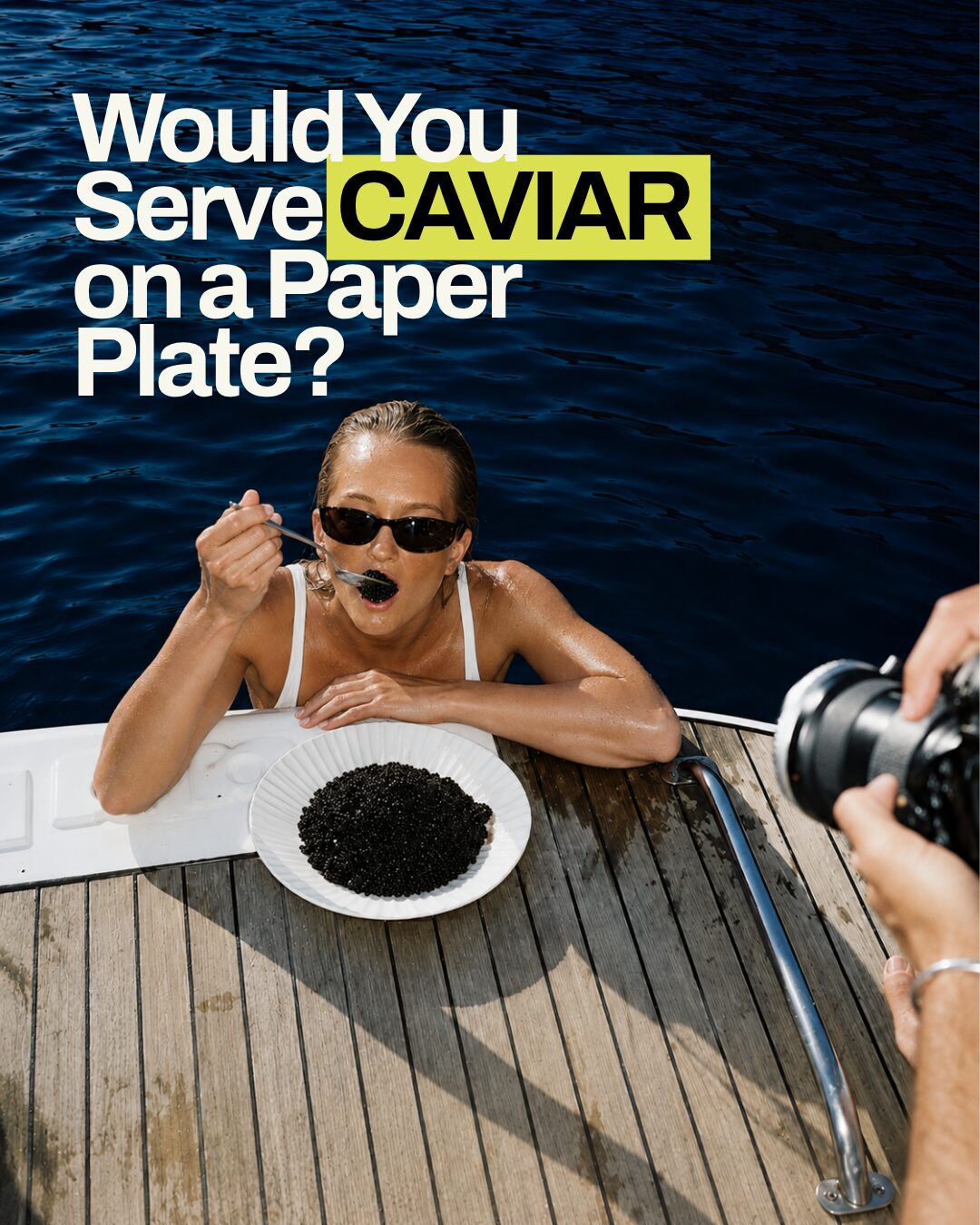
Would You Serve Caviar on a Paper Plate?
There is nothing wrong with serving something simple on a paper plate.
There is nothing wrong with caviar either.
The problem is when the two turn up together and everyone acts surprised the whole thing feels a bit off. That is not a paper plate problem. That is a mismatch problem.
Creative budgets work exactly the same way.
There is no correct amount to spend on a campaign, a shoot, a brand identity or a piece of content. A small budget can produce something brilliant. A huge one can be blown on something forgettable. Money was never the idea. It was only ever fuel for one.
But there is a point where what a business is asking for and what it is willing to pay for stop being the same conversation.
You want something that feels big. Cinematic. Premium. Talent who know what they are doing, a location that does half the work for you, photography and film, original music, six months of content pulled from one shoot.
Then the budget shows up, and it is for a completely different job.
Neither side is being unreasonable on its own. They are just not talking about the same project anymore.
The budget is part of the idea, not a number bolted on afterward
Budget conversations usually happen like the money lives somewhere separate from the creative thinking. First there is the dream version of the idea. Then, much further down the page, there is the number available to make it real.
We think those two things need to meet a lot earlier than that.
What you can spend shapes what kind of idea actually makes sense. It shapes who can be involved, how much time the work gets, and how many things you can realistically ask one project to do. That is not a limitation. Half the time, it is exactly what makes the work interesting.
Constraints force decisions. If you cannot afford four locations, maybe the answer was never four locations. It was one location, used properly. If ten polished films were never going to fit the budget, maybe the brief should not have asked for ten films in the first place.
The goal is not a bigger budget. The goal is an idea that is honest about the budget it actually has.
Premium was never a synonym for expensive
This is where things get muddled.
Premium does not mean an enormous production. It does not require a helicopter, a celebrity, or a location on the other side of the world. Plenty of expensive creative is completely forgettable. Plenty of simple creative feels elevated because every single decision behind it was made with confidence.
Premium is consideration. It is the difference between adding something because the budget technically allows it, and knowing precisely what the work does not need.
It is a casting choice that makes the whole idea believable. A photographer whose eye changes how a product reads. A piece of original music that makes a film feel like it belongs to the brand and not the category it sits in. Sometimes it is just giving people enough time to actually do the job properly instead of rushing it.
All of that costs money. But the money is not what makes it premium. The judgement behind spending it is.
Which means a smaller budget does not have to feel cheap. It just needs an idea built for the reality it has, instead of a shrunken version of something that was always too big for it.
There is nothing wrong with a beer budget
There really is not.
A beer budget can make something brilliant. The problem starts the moment the brief still expects champagne.
This happens constantly, and honestly, it is understandable. Clients do not see everything sitting behind the finished thing. They see the photo, not the hours of pre production that put every single element inside that frame. They see thirty seconds of film, not the people, gear, location, edit, grade, sound and planning that thirty seconds is actually made of.
The finished work looks effortless because a lot of effort went into making it look that way.
That is also why two projects can look nearly identical on paper and cost completely different amounts. It was never just about how many hours went in. It is about what had to happen to make those hours worth something.
You are not paying for the hours
A lot of people price creative and marketing work by the hour, and on the surface it sounds fair. More time, more money.
In reality, it punishes the exact thing you are supposed to be paying for.
If someone is genuinely good at their job, especially in design and marketing, that speed did not come from nowhere. It came from years of getting it wrong, learning what works, and building the kind of instinct you cannot fast forward your way into. So when that person does the job faster and better than someone still learning, why would that mean they get paid less for it? Under an hourly model, it does. The expert, who solves the problem in an hour, earns less than the beginner who takes five hours to arrive at a worse result. That is not logical. That is backwards.
You are not hiring a social media manager because you physically cannot type a caption. You are hiring them because they know what to say, when to say it, and why it is going to work. The typing was never the value. The thinking behind it always was.
Photography works the same way, and people miss it for the same reason. Anyone can point a phone at something and take a photo. What you are actually paying a photographer for is not the click. It is the years spent learning light, composition, timing, and how to direct a real person in front of a camera so the photo actually lands. The gear is not the product. The judgement behind it is.
This is a big part of what MOK’HOUSE runs on. Not equipment. Not hours on a timesheet. Experience, built across every industry we have worked in, that tells us what is actually going to work before we make it.
More deliverables does not automatically mean more value
There is a specific moment in budget conversations where value quietly turns into volume.
If twelve assets cost a certain amount, twenty four must be better value. Right?
Not always.
If the same budget now has to stretch across double the deliverables, something gives. Less time per asset. Less attention. Less chance for any single piece to actually be considered properly. Eventually you have to ask whether the brand needed twice as much creative, or whether a longer list on a scope document just felt reassuring.
We would rather the work earn its place. Sometimes a bigger asset bank makes total sense, because the production was built to support it. Other times, putting everything into fewer, stronger pieces gives a brand more useful material than manufacturing endless variations just to hit a number.
More output is not automatically more value. Sometimes it is just more output.
Cutting the wrong thing gets expensive fast
Reducing a budget is not automatically a problem. A good creative partner should be able to have an honest conversation about where something can be simplified without losing what made the idea good in the first place.
But not every line item is interchangeable.
There is a real difference between cutting something unnecessary and cutting the thing that was doing most of the work. A business might save money by picking a location that almost fits, cutting production time, or using creative that is close enough to what they actually wanted. On the spreadsheet, that saving shows up immediately.
The cost to how people perceive the brand is a lot harder to see, until it is not.
This matters most when the creative is introducing or repositioning a brand. It might be the first thing thousands of people ever experience from that company. If you are asking that work to say quality, authority, or a real shift in direction, everything around it has to back that up.
This is the caviar problem again. The product can be excellent. The plate is still part of the experience.
Spending more only matters if it actually changes something
None of this is an argument for spending money you do not need to spend. There is no strategic upside in convincing someone to pay fifty thousand dollars when fifteen would solve it brilliantly.
The real question is what the extra spend actually buys. Does it get you talent that genuinely improves the idea. Does another production day give the team room to make something different instead of just more of the same. Does original music give the brand something ownable, where stock music would only ever be background noise. Does the location change how the product is perceived enough to justify what it costs.
If the answer is no, that money belongs somewhere else.
Google’s published case study with Tele2 looked at exactly this, examining how specific creative choices affected advertising ROI. It found that how an idea gets executed can genuinely change how it performs once it is out in the world. The argument was never that expensive creative performs better. It was that creative decisions have consequences, and the investment should go where those consequences actually land.
A smaller budget deserves a better idea, not a cheaper copy of a bigger one
The biggest mistake in creative budgeting is starting with an idea built for a completely different level of production, then chipping pieces off it until the numbers work.
Something always gets lost along the way.
The better move is starting over. If this is the money on the table, what is the strongest thing we can build with it? That question is more freeing than it sounds. It removes the pressure to copy a campaign the budget was never built for, and opens up room for an idea that works because of its constraints, not despite them.
One properly considered photograph can carry more weight than an elaborate shoot compromised at every stage. A simple film can hit hard if the idea does not need spectacle. A smart piece of social first creative can outperform something ten times the cost, because it actually understood the platform and the people watching it.
The goal was never to make a small budget look like a big one. It is to make every budget look intentional.
Ambition and investment need to actually know each other
The best budget conversations happen when nobody is pretending. The client is honest about what they can spend. The creative team is honest about what that buys. Together, you work out where the money matters most.
That might mean scaling back. It might mean spending more. It might mean realising the original idea was more complicated than it needed to be, and the better version costs less.
All three of those are good outcomes, because the goal was never to max out the budget. It was to line up the ambition of the work with what you actually have to make it.
We would always rather have that conversation early. It means we build the idea around the reality of the project, instead of designing something beautiful and slowly stripping away everything that made it beautiful to begin with.
There is nothing wrong with caviar. There is nothing wrong with a paper plate.
There are moments where both are exactly right.
We just think it is worth knowing which experience you are actually trying to create before you set the table.
A business can have an exceptional product, a brilliant team and a very clear idea of what it stands for, but that clarity only gets you so far if nobody outside the company can see it. This is where creative tends to be misunderstood. It is still often treated as the layer applied once the […]
MOK’HOUSE operates as a creative production house, connecting strategy, design, content, production, music and digital capability through a flexible project-led model.

A case study on how MOK’HOUSE used Meta Ads to help Phoenix Performance grow a high-performance athlete program through strategy, creative testing and long-term optimisation.
Indigenous procurement is more than a policy requirement. Discover how genuine partnerships, cultural understanding and long-term collaboration create lasting value for organisations, communities and the creative industry.