A well-planned content shoot should create more than a handful of posts. MOK’HOUSE explores how creative production can build a wider bank of brand, campaign and social assets.
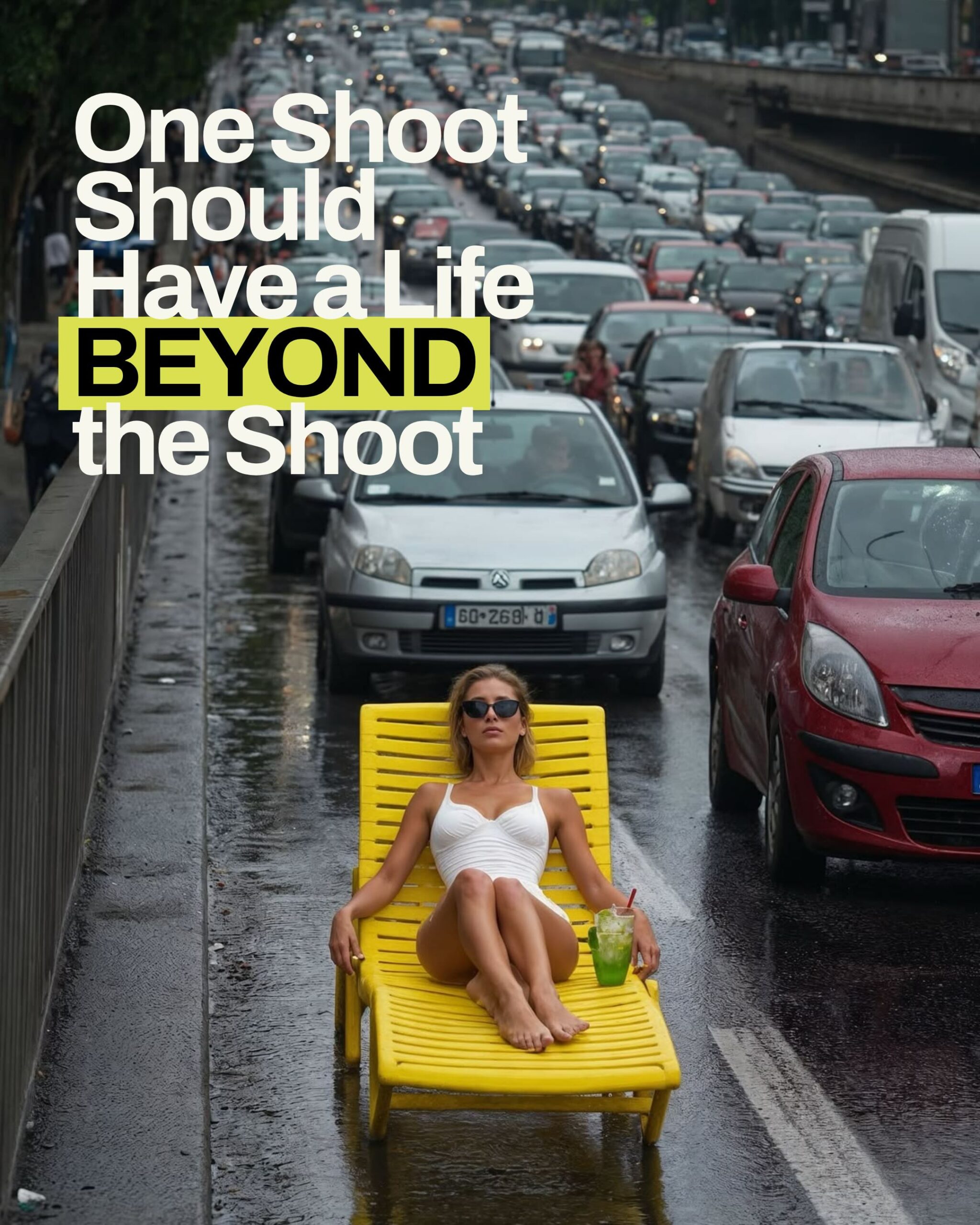
One Shoot Should Have a Life Beyond the Shoot
A shoot can last eight hours.
The work it creates should last considerably longer.
It sounds obvious, but somewhere along the way content production became increasingly tied to the immediate need in front of it. A campaign needs launching, the social calendar needs filling or a website needs new photography, so a shoot is organised around solving that particular problem.
The day happens. The selects are delivered. The campaign goes live.
And three weeks later, somebody is asking what there is left to post.
We think a shoot should be planned with a much longer life in mind.
Not because every piece of footage needs to be repurposed into twenty-seven different assets, or because more content is automatically better. Quite the opposite. Good creative production is about understanding the wider life of the work before the cameras arrive, so the things being created have somewhere meaningful to go.
A shoot shouldn’t simply produce content. It should build creative infrastructure for the brand.
The shoot starts long before the camera does
Some of the most valuable decisions made on a production happen before anybody steps onto set.
There is the obvious planning: location, casting, styling, shot lists and production schedules. But the more interesting conversation is about what the business actually needs from the day.
Where will this work live once it exists? What does the campaign need that the website doesn’t? What could paid media require three months from now? Is there an opportunity to capture something more editorial alongside the hero imagery? Will the brand need vertical film as well as widescreen? Could the same environment give us a completely different story if we change the way we frame it?
Those questions change the shoot.
They affect the compositions being captured, the amount of negative space left for copy, the way talent moves through a scene and even how long the camera stays rolling after the obvious shot has already been achieved.
This is where creative production becomes strategy rather than logistics.
When the wider use of the work is considered early, a single production can begin creating a genuinely useful visual library rather than a folder of beautiful files that all essentially do the same thing.
That thinking sits behind the way we approach creative production at MOK’HOUSE. The objective isn’t simply to leave a shoot with more assets. It is to leave with the right ones.
A hero campaign and a content bank are not the same thing
There is still an important place for the hero image.
A campaign needs a point of view. It needs the photograph that carries the idea, the film that sets the tone and the pieces of creative that make the whole thing feel like a moment rather than an assortment of deliverables.
But the hero work doesn’t have to exist in isolation.
One of the missed opportunities in content production is treating campaign imagery and everyday brand content as completely separate worlds. The result is often a beautiful launch followed by weeks of material that bears very little relationship to it.
A better production can hold both ideas at once.
The hero assets establish the visual world, while the wider capture builds enough depth around that world for the brand to continue inhabiting it. A close-up that would never make the campaign billboard might be perfect six weeks later. A few seconds between takes might become the strongest piece of social-first footage from the entire day. An alternate crop can give paid media space to test a different message without commissioning an entirely new piece of creative.
The value is not in squeezing every possible asset out of a production.
It is in creating enough range that the original idea can continue to live without becoming repetitive.
Every platform asks something slightly different of the work
The same creative does not always behave the same way everywhere it appears.
An image built for a website banner needs something different from an Instagram Reel. A paid advertisement has different constraints from a campaign film. Social content often needs to make sense without the context surrounding a larger brand campaign, while a landing page may need enough visual restraint to allow the product or message to do the work.
Platforms themselves reflect this reality. Meta’s guidance around ad creative strategy encourages advertisers to consider different placements, formats and visual treatments rather than assuming one execution will work identically everywhere.
For us, that doesn’t mean turning a production into an endless exercise in resizing.
It means acknowledging that where the work is going can influence how it should be captured in the first place.
If we know a piece will eventually need to live vertically, we can protect the composition for that format while shooting. If paid media is part of the plan, we can create enough genuine creative variation to test ideas rather than producing five almost identical edits after the fact. If the website needs imagery with room for typography, that consideration belongs on the shot list before the photographer begins composing the frame.
Small decisions made on the day can save a surprising amount of compromise later.
The best moments aren’t always on the shot list
There is another reason we like to think beyond the obvious deliverables: shoots have a habit of giving you things you didn’t know you needed.
A great production has its own energy. People settle into the environment. The light changes. Somebody moves differently. The talent laughs immediately after the take ends. A stylist adjusts something in a way that suddenly makes the frame better than the version everybody planned.
Those moments are difficult to manufacture later.
It is why social-first capture can be particularly valuable alongside more traditional campaign production. The polished work and the looser material don’t have to compete with one another. Often, they make the brand feel more complete.
One establishes the world.
The other lets people into it.
Some of our selected work at MOK’HOUSE has been built around exactly that idea: capturing material that can feel considered enough for the brand while still being natural enough to belong where people are actually consuming it.
The goal isn’t to turn every behind-the-scenes moment into content.
It is to recognise when something worth keeping is happening outside the formal frame.
A content bank should create freedom, not clutter
There is a version of this approach that goes too far.
Hundreds of photographs are delivered. Hours of footage are uploaded. Everybody feels reassured by the sheer volume of files sitting in the folder.
Then nobody knows what to do with any of them.
A useful content bank is not simply a large content bank.
It has range without becoming directionless. There is enough consistency that the assets belong to the same brand, but enough variation that they can tell different stories. Some material is polished, some is more observational, some gives the product room to lead and some exists purely to build the feeling around the brand.
Most importantly, there should be an understanding of why the material was captured.
When that thinking happens before production, the library becomes much easier to use afterwards. The marketing team isn’t endlessly searching through folders hoping to find something that happens to fit the next brief. There is already intention built into the material.
That is a far more useful measure of a successful shoot than the number of final files delivered.
Production should make future creative easier
There is a commercial side to this too.
Productions require budget, time and a lot of people making a lot of decisions in a relatively short period. Once the location is secured, the talent is there, the styling is right and the creative world has been built, there is value in thinking carefully about what else the business may reasonably need from that environment.
That doesn’t mean adding more for the sake of it.
It means making the investment work harder.
A considered production can give a brand material for the campaign it is launching now while also creating a foundation for the weeks and months that follow. It can provide the visual language for paid media, give social teams somewhere to go next and create assets that still feel relevant when the initial launch moment has passed.
It also creates consistency almost by default. When more of the brand’s material comes from a shared creative world, the audience is more likely to experience a brand that feels connected rather than one that seems to reinvent itself every week.
That continuity is valuable.
It helps creative accumulate instead of constantly starting over.
We think about the life of the work before we make it
At MOK’HOUSE, we don’t see the shoot day as an isolated event.
It sits inside something larger.
There is the strategy that brought us there, the creative idea that shaped the production and the places the work still needs to travel after everybody has packed down and gone home.
Thinking about those things together changes what gets made.
It means asking whether the campaign photograph can exist somewhere beyond the campaign. Whether the six-second moment between takes might have more value on social than another carefully scripted clip. Whether the footage being captured today gives the brand enough freedom to tell a new story next month without abandoning the visual world it has already invested in.
A good shoot gives you what you came for.
A great one gives the brand somewhere to go afterwards.
Because the value of creative production isn’t limited to what happens on set.
One shoot should have a life far beyond the shoot.
Give the shoot somewhere else to go
If you’re already bringing the people, location, talent and creative world together, there is an opportunity to capture more than the hero campaign.
MOK’HOUSE offers social-first behind-the-scenes capture alongside productions, creating the candid, in-between and platform-native moments that can extend the life of a shoot across social long after the main assets have been delivered.
It isn’t about turning every moment on set into content. It is about having someone there specifically thinking about what the audience will want to see beyond the final frame, and capturing it while the moment is actually happening.
Planning a shoot, campaign or production? [Talk to MOK’HOUSE about social-first capture.]
A business can have an exceptional product, a brilliant team and a very clear idea of what it stands for, but that clarity only gets you so far if nobody outside the company can see it. This is where creative tends to be misunderstood. It is still often treated as the layer applied once the […]
MOK’HOUSE operates as a creative production house, connecting strategy, design, content, production, music and digital capability through a flexible project-led model.
A case study on how MOK’HOUSE used Meta Ads to help Phoenix Performance grow a high-performance athlete program through strategy, creative testing and long-term optimisation.
Indigenous procurement is more than a policy requirement. Discover how genuine partnerships, cultural understanding and long-term collaboration create lasting value for organisations, communities and the creative industry.